

In 2026, the cross-disciplinary dialogue between science and traditional Kogi knowledge is established at six pilot sites
In 2023, Arregocés Conchacala (Kogi governor) concluded the second cross-disciplinary assessment with these words:
“It would be good to find a pilot site in Colombia, and one, two, three… in France, to experiment with this dialogue and put it into practice, to work together and find bridges between our two sciences.”
A wonderful invitation to experiment, in willing communities, with new approaches to care and resilience! Another step towards transforming our perspectives, renewing our connection to life and nurturing inspiring narratives capable of influencing practices, policies and science.
In 2026, six pilot sites will host this dialogue between the Kogi’s ancestral knowledge and modern science, to bring forth new ways of being, doing and acting together.
- The Géolab de La Comtesse in Val Maravel (Haut-Diois) will further explore the regeneration of the mid-mountain region, building on the Kogis’ visits.
- The Abbey of Saint-Maurice (Valais, Switzerland) will explore the memories of the territory through its sacred spring, its stone paths and its Celtic traces.
- The Chablis vineyards (Burgundy, 200 ha under biodynamic cultivation) will examine their practices in the face of climate change.
- Les Fontaines de Notre-Dame du Planté (Loire-Atlantique) will combine local knowledge with scientific analysis of water quality and composition.
- The Brie and Deux Morin Regional Nature Park (Seine-et-Marne) project will focus on soil fertility, water and land management.
- The Paris-Saclay Laboratory of Nanosciences and Nanotechnologies (C2N) invites you to delve into matter, at the heart of knowledge-building.
In 2023, Shikwakala, the second cross-regional health assessment!
“Shikwakala”, our second cross-sectoral regional health assessment, focused on the Rhône basin following an initial review in 2018 in the Drôme.
From 25 September to 17 October, the Tchendukua – Ici et Ailleurs association brought together five representatives of the Kogi indigenous people, including their Governor Arregocès Conchacala, and European scientists to heal the Earth together.
In addition to field studies, other events were held: conferences, workshops, discussions with young people… Meetings with elected representatives in France and Switzerland also took place.
Finally, a major public conference organised on 15 October 2024 at La Scène Musicale in Paris brought the initiative to a close and presented the findings of this assessment, in the presence of the Kogi delegation, scientists and experts such as:
Barbara GLOWCZEWSKI
Emma HAZIZA
Béatrice and Gilbert COCHET
Erik ORSENNA
Cédric VILLANI
In 2018, a cross-diagnostic assessment in the Drôme… a first!
At the suggestion of their political authorities in conjunction with Tchendukua – Ici et Ailleurs, in September 2018, three Kogi shamans (two Mamas and one Saga) agreed to travel to France, to the Drôme region and more specifically to the Haut-Diois area, to contribute to a cross-diagnosis of the region’s health. Their perspectives, their questions and their assessments were cross-referenced with the perspectives, questions and diagnostic findings of researchers from our modern societies, including:
Denis CHARTIER, Environmental Geographer, Senior Lecturer (HDR), University of Orléans
Gilbert and Béatrice COCHET
Patrick DEGEORGES, Philosopher, Director of the Anthropocene School at the ENS in Lyon
Roch DOMEREGO
Alan EREIRA
Pierre and Françoise GRENAND
Pierre-Yves LONGARETTI
Béatrice MILBERT
Ioan NEGRITIU
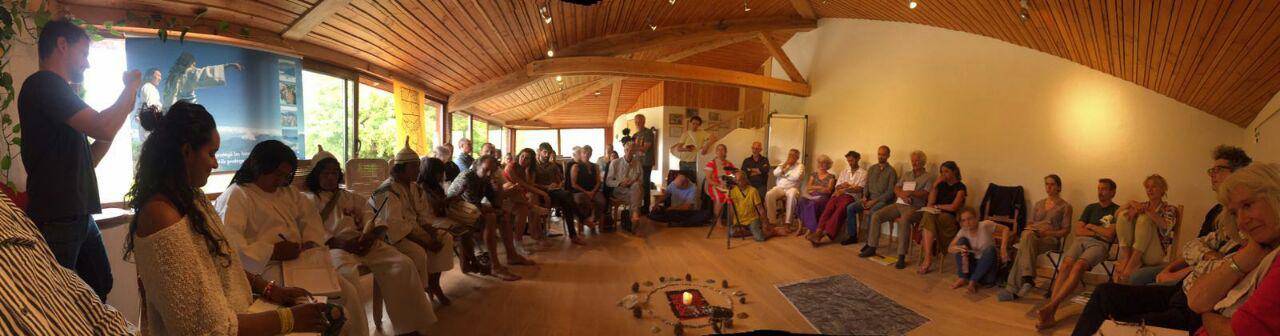
What is a territory? How, and on what basis, can we perceive and appreciate its overall balance? What links can be established between ‘territorial health’, human health and ‘societal’ health? What might be the pathways to territorial resilience? What might be the pathways to “integrated” or “inclusive” territorial health?
These are some of the questions that were explored and debated during the 12 days of this experiment in France. The outcomes of this dialogue and any summary findings that can be drawn will be disseminated and shared through our partners: the École Normale Supérieure de Lyon, the Universities of Lampeter (Wales), Colombia, Brazil, Malaysia, the USA (Oregon) and Switzerland (Lausanne)
With the support of the Ministry for Ecological Transition, the French Development Agency, the Ministry of Foreign Affairs, the Tairona Heritage Trust and the Lunt Foundation.
“For the Kogi people, the concept of ‘health’ encompasses several dimensions: the health of the individual, the family, the group, the community and the land; these interrelated dimensions contribute to the overall health of a living system. These are addressed both on a material level and, above all, on a spiritual level. Health is understood in a more preventive than curative sense, or rather as a means of avoiding the imbalances that give rise to problems and illnesses. To achieve this, one must respect the ‘order’ of things (Ordenamiento territorial), of which the territory is the expression. To respect the ‘order’ of things, one must know the ‘Ezuamas’, these territorial ‘healing’ points whose interrelationships and connections enable the maintenance of the great balances.”
Arregoce CORONADO